A Pretty Poinsettia Crochet Flower to Make This Season
Bring the timeless beauty of the holidays indoors with this elegant, handmade poinsettia. This crochet flower is a wonderful project for the season, perfect for decorating wreaths, gifts, or your own festive displays.
The Poinsettia Parts: Petals and Leaves
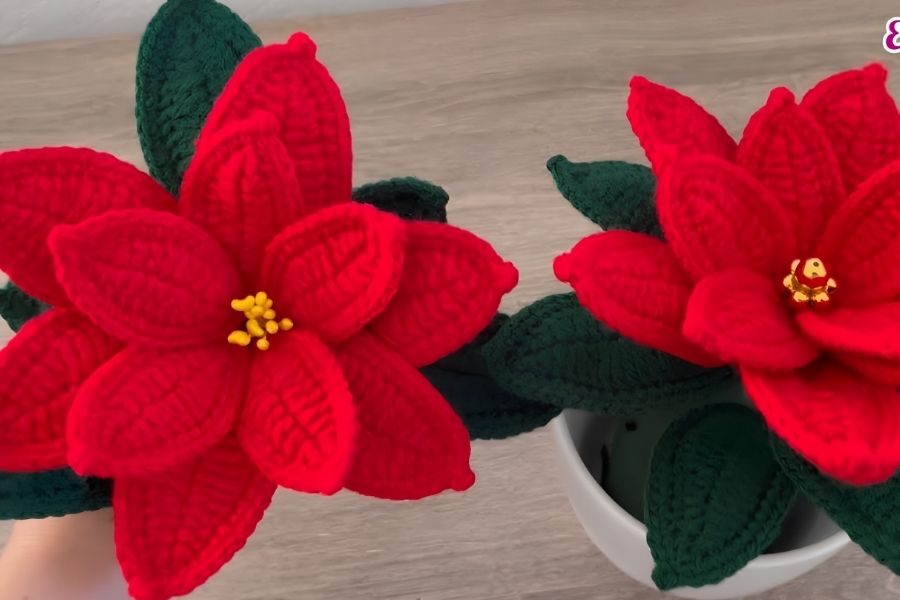
Each poinsettia flower is built from a collection of crocheted pieces. You will need to make six large petals and five small petals. These petals are what create the beautiful, vibrant red star shape that poinsettias are known for.
In addition to the petals, you will crochet seven distinct green leaves. These leaves provide a lovely contrast and form the base of the flower, making it look more realistic and lush. The pattern for all these pieces is essentially the same, just with different starting chain lengths to achieve the varied sizes. You start by making a slip knot and then crocheting a chain. For example, the leaves start with an 18-chain, while the larger petals begin with a 15-chain. The construction involves working along both sides of the chain, creating a central rib.
The magic of this pattern comes from using a wide range of basic and tall stitches. The process begins simply with single crochets and half double crochets near the start of the chain. As you move toward the middle of the petal or leaf, the stitches get taller: you’ll use double crochets, extended double crochets, and then very tall triple crochets. When you reach the tip, you’ll make multiple single crochets in the last chain to create a rounded point. Then, you repeat these stitches in reverse order on the other side of the chain, mirroring your work to form the leaf shape. This gradual increase in stitch height is what gives the pieces their beautiful curved form.
Shaping and Assembly
Once the basic petal or leaf shape is crocheted, the next round is crucial for giving it structure. This is where you incorporate a thin wire. As you crochet single stitches all the way around the perimeter, you trap the wire inside the stitch, allowing you to bend and pose each petal and leaf into a perfect, realistic shape. When you reach the tip, you create a small picot—a little decorative loop—with a chain and slip stitch to define the point of the leaf or petal.
The center of the poinsettia can be made in a couple of ways. One option is to create small yellow French knots on a stem. Another beautiful and easier method involves threading small beads onto a wire, twisting them into clusters, and arranging them in the middle. Finally, you assemble the flower by layering the six large petals, then the five small petals, and wrapping them together with floral tape. The green leaves are attached last to the base of the stem.
Tips and Tricks for a Perfect Flower
Take your time with the wire placement on the second round. It can be a bit tricky to catch the wire inside the single crochet stitches, but it’s worth the effort for the shape it provides. If the wire slips, just undo that stitch and try again. Don’t worry if the wire end shows a little bit; you can cover it when you wrap the stem with floral tape.
The variety of stitches from single crochet up to triple crochet is key to the petal’s form. Pay close attention to the instructions for when to use which stitch. This careful transition is what makes the petals curve and look so lifelike. If you get confused, count your stitches carefully; matching stitch counts on both sides of the leaf is important for symmetry.
For the flower center, using beads adds a lovely, sparkling touch that catches the light, much like the natural centers of real poinsettias. The beaded wire clusters are quite simple to make and offer a very professional-looking finish. Experiment with different shades of yellow or even gold beads to get the look you love best.
Remember that each flower is unique. Don’t be discouraged if your first petal isn’t perfect. With each one you make, you’ll get faster and the results will look better. Have fun with this project and enjoy giving these handmade gifts or displaying your beautiful poinsettia for all to see.